
Cycle-Alignment 101: Where to Begin
Not optimization. Alignment.
There is a particular kind of tired that comes from being told, every week, that you should be doing more. Sleep better. Eat cleaner. Hack your hormones before breakfast. Be the most luminous version of yourself by Tuesday, please and thank you.
If you are reading this, you have probably already opened a few of those tabs. You closed them again. You felt a little smaller for trying.
This is not that.
This is a letter from someone who has been quietly tending her cycle for a while now, with a kettle on, and who wants to tell you what she knows. Not so you can master anything. Just so you can begin.
The thing about your cycle
Your body has been doing this forever. Long before there were apps, or supplements, or twelve-step morning routines, women were moving in rhythm with something ancient and internal. The cycle is not a problem you are meant to solve. It is a season you are meant to notice.
Cycle-alignment is simply the act of paying attention. Of asking, gently, what does my body want this week, and then offering it that — a soft walk, a bowl of bone broth, an early bedtime, a long conversation, a salad with citrus, a no.
It is not biohacking. It is not optimization. It does not require six new supplements or a colour-coded spreadsheet.
It is closer to gardening. You learn what blooms when, and you stop trying to grow tomatoes in February.
Meet your four seasons
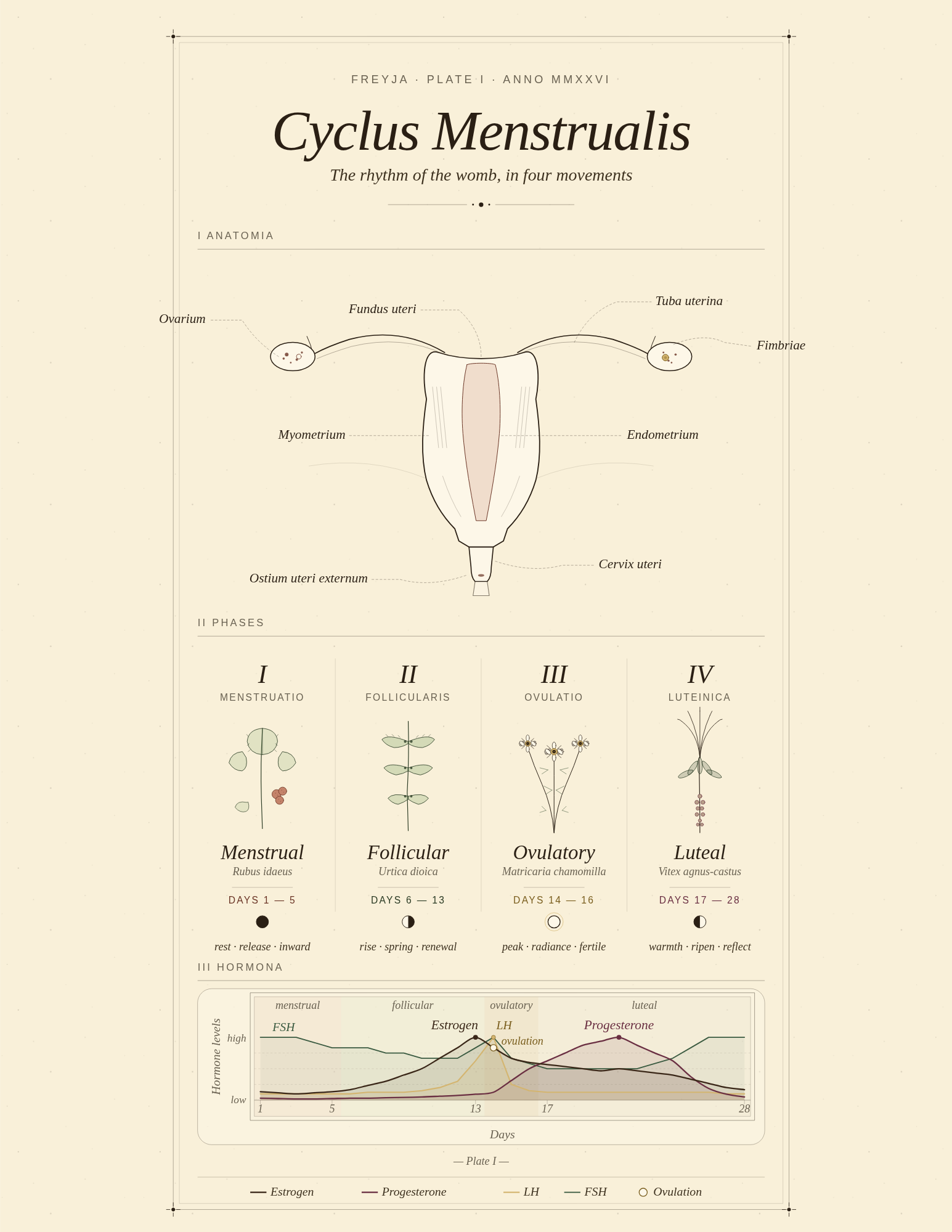
A typical cycle runs anywhere from twenty-one to thirty-five days, with twenty-eight as the average. Inside those days, your body moves through four distinct phases — four interior seasons that arrive in the same order, every month, whether you are watching or not.
Menstrual, days 1 to 5. Winter. The lining sheds, energy quiets, and the body asks for stillness. This is the bleed.
Follicular, days 6 to 13. Spring. Estrogen begins its slow climb, and with it, the appetite for newness — new ideas, new movement, new conversations.
Ovulatory, days 14 to 17. Summer. The peak. You may feel more social, more confident, more outward. This is when an egg is released and the body is at its most extroverted.
Luteal, days 18 to 28. Autumn. Progesterone rises, then falls. The mood draws inward. The body wants warmth and grounding and, often, dark chocolate.
That is the whole shape of the month. You do not have to memorize it. You only have to know it is there.
The four-season framework is the whole shape of our field guide, which you can have for free if it would be useful.
Two hormones doing most of the talking
There are four hormones at work across the cycle, but two of them carry the loudest voices.
Estrogen peaks just before ovulation. It is the bright, outward hormone — the one that lifts mood, sharpens thought, and quietly conducts a great deal of what happens in the body. When estrogen is rising, you are likely rising with it.
Progesterone builds after ovulation, released by the very follicle that let go of the egg. Its temperament is calmer. It steadies, it softens, it makes you want a warm bath and an early evening. When progesterone falls at the end of the cycle, the bleed begins, and the whole quiet wheel turns again.
The other two — FSH and LH — do important work backstage. You do not need to befriend them. Estrogen and progesterone are the two to know first.
How to listen
The most useful thing you can do, in the beginning, is track. Not in a clinical way. In an I'm getting to know someone way.
Notice the first day of your bleed — actual bleeding, not spotting. That is day one. The start of the whole cycle.
Notice the cramps. They are the uterus working, contracting to release. They sometimes appear around ovulation, too.
Notice the headaches that come when hormones swing — often mid-luteal, often during the bleed itself.
Notice the cravings, the bloat, the sleeplessness, the bright energy on a Tuesday, the inexplicable urge to reorganize a closet on a Thursday. Notice rage. Notice softness. Notice the days you feel spicy and the days you feel sad.
None of these are flaws to be edited. They are the body, talking. The work is only to listen.
Mapping your cycle
Once you have tracked for a month or two, the pattern begins to come forward on its own. You start to recognize the phase you are in by how you feel, not by the date on a calendar.
In the menstrual days, you will likely feel low-energy, inward, craving rest. This is correct. Rest.
In the follicular stretch, you may feel clear, motivated, ready to begin. Begin.
At ovulation, you may feel confident, social, your most outward self. Be seen.
In the luteal descent, you may feel grounded, sensitive, drawing in. Draw in.
A cycle is not a performance review. There is no phase that is better than another. Each one is asking for something different, and the gift of alignment is that you stop asking yourself to be the same person on day 3 as on day 14.
Living with each phase
This is the part that becomes practical. Each phase has a different appetite — for food, for movement, for ritual. None of it is prescriptive. It is simply what tends to feel good when.
Menstrual. Slow, restorative movement — walking, gentle yin yoga, stillness. A warm compress on the lower back for ten minutes, eyes closed. On the plate: beef, lentils, eggs. Spinach, kale, beets, sweet potatoes. Bone broth, quinoa, oats. Ginger, turmeric, dark chocolate.
Follicular. New forms of movement — a class you haven't taken, a hike you haven't walked. A morning walk with sunlight on your face. Chicken, greek yogurt, tofu. Broccoli, arugula, carrots, berries. Brown rice, quinoa, flaxseeds. Sauerkraut, kimchi, lemon.
Ovulatory. Vigorous movement — run, dance, lift. Ask your body and it will answer. A long meal with people you love; be seen, let them see you. Salmon, shrimp, eggs. Leafy greens, tomatoes, zucchini, berries. Chia seeds, whole grains. Fresh herbs, citrus.
Luteal. Grounded movement — yoga, pilates, long walks. A warm bath with epsom salts. Turkey, chicken, chickpeas. Spinach, squash, cauliflower. Brown rice, whole grains. Dark chocolate, cinnamon.
None of this is a rule. It is a suggestion offered the way a sister might pass you a cup. Try this. See how it feels.
A gentle close
There is no streak to maintain here. No level to unlock. No premium version of yourself waiting on the other side of perfect compliance.
There is only this: a body, doing what it has always done, asking you — quietly, without insistence — to notice. To eat in rhythm. To rest when winter comes. To bloom when it is spring.
Begin with one cycle. Watch what arrives.
That is the whole assignment.